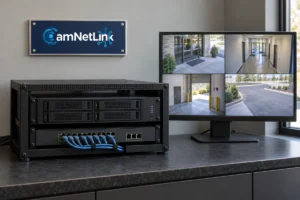

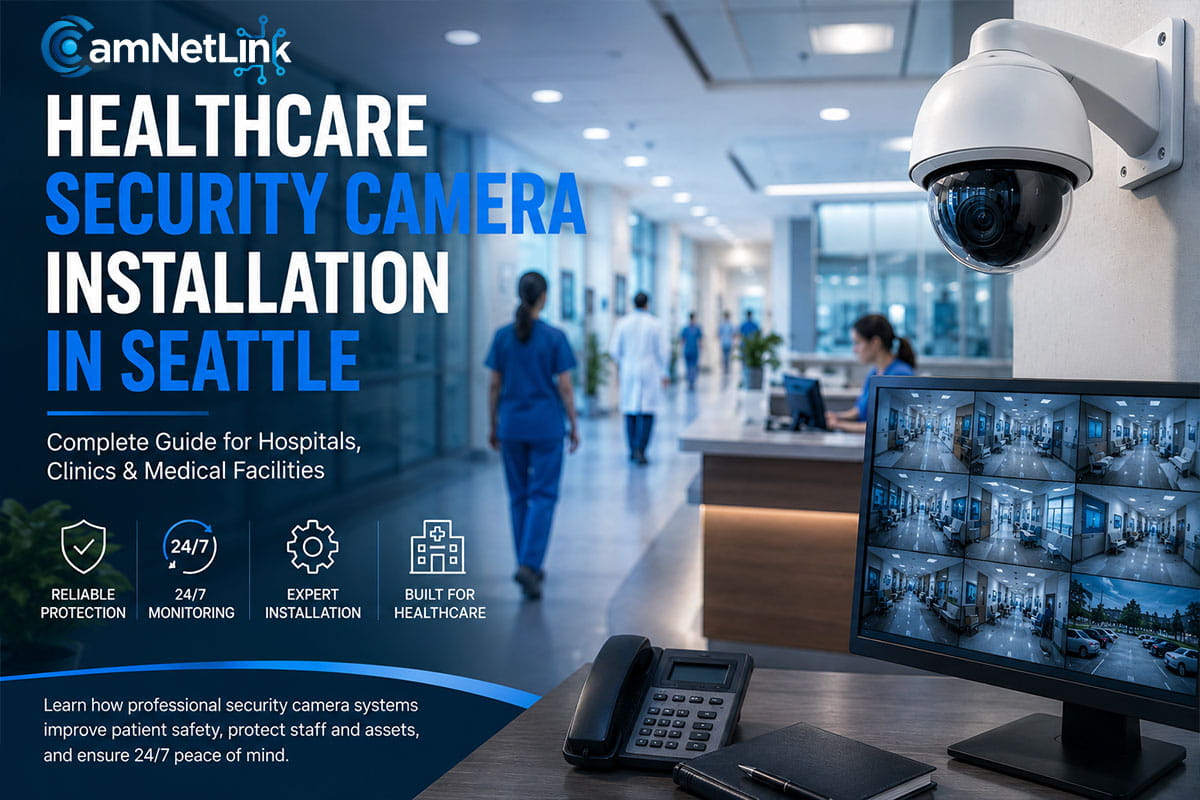
Healthcare Security Camera Installation Seattle helps hospitals, medical clinics, dental offices, outpatient centers, laboratories, and other healthcare facilities create safer environments for patients, employees, visitors, and valuable medical assets. Healthcare properties operate around the clock and often contain restricted areas, expensive equipment, medication storage, sensitive workspaces, and busy public entrances. A professionally designed surveillance system gives facility managers greater visibility while supporting security, incident response, and day-to-day operations.
Modern healthcare surveillance is much more advanced than traditional CCTV. Today’s systems can combine 4K IP cameras, Artificial Intelligence (AI), secure video management, remote monitoring, Power over Ethernet (PoE), License Plate Recognition (LPR), and intelligent event detection. The goal is not simply to record video, but to build a reliable security infrastructure designed around the actual workflow and risks of the medical facility.
At CamNetLink, we provide professional Healthcare Security Camera Installation Seattle solutions for hospitals, clinics, medical offices, dental practices, laboratories, rehabilitation facilities, and other healthcare properties throughout Seattle and surrounding areas. Each system is planned around the building layout, access points, operational requirements, existing network infrastructure, and future expansion needs.
Why Healthcare Facilities Need Professional Video Surveillance
Healthcare environments present security challenges that are different from those of ordinary offices or retail businesses. Patients and visitors continuously enter and leave the property, employees may work during overnight shifts, deliveries arrive throughout the day, and certain areas must remain accessible only to authorized personnel.
Professional Medical Facility Security Cameras Seattle can help administrators monitor entrances, reception areas, corridors, parking areas, loading zones, building perimeters, and other appropriate locations where additional visibility is needed.
When an incident occurs, properly positioned cameras can provide useful recorded evidence for internal investigations, property damage claims, security reviews, and other authorized purposes.
Common Security Challenges in Healthcare Facilities
No two medical properties have exactly the same risks. A neighborhood dental office may require a relatively compact surveillance system, while a hospital or multi-building healthcare campus can require dozens of cameras connected through enterprise-grade network infrastructure.
- Unauthorized building access.
- Theft of equipment or property.
- After-hours trespassing.
- Parking lot incidents.
- Restricted-area access.
- Visitor-related security incidents.
- Vandalism and property damage.
- Loading and delivery area activity.
- Employee safety concerns.
- Incident documentation and investigation.
Benefits of Healthcare Security Camera Installation Seattle
A properly engineered surveillance system can support both security and facility management. Rather than relying on isolated cameras, professional installations create coordinated coverage across the areas that matter most.
- 24/7 surveillance of appropriate facility areas.
- Improved visibility at entrances and exits.
- Faster verification of security events.
- Protection of expensive equipment and property.
- Remote monitoring for authorized personnel.
- AI-assisted event detection.
- Better parking and exterior visibility.
- Recorded evidence for incident investigations.
- Scalable infrastructure for future expansion.
- Centralized management of multiple cameras.
Healthcare Facilities That Benefit from Professional Surveillance
Hospitals and Medical Campuses
Hospitals often contain multiple entrances, emergency departments, parking areas, administrative spaces, loading zones, and restricted sections. A professionally designed Hospital Security Camera Systems Seattle solution can provide centralized visibility across these environments while allowing the surveillance infrastructure to scale as facility requirements change.
Medical Clinics
Clinics generally require focused coverage around entrances, reception areas, corridors, exterior spaces, and other suitable common areas. Camera placement should be carefully planned so security objectives are met without treating every part of the clinic as a surveillance zone.
Dental Offices
Dental practices contain valuable equipment, computers, supplies, and business records. Cameras around entrances, reception spaces, parking areas, and appropriate staff or common areas can strengthen overall property security.
Laboratories and Diagnostic Facilities
Laboratories may contain specialized equipment, controlled workspaces, and high-value materials. Surveillance can complement access control by providing visual verification around entrances and other designated security areas.
Rehabilitation and Outpatient Facilities
Facilities with frequent patient and visitor traffic can benefit from professionally planned surveillance at public entrances, exterior areas, reception spaces, parking lots, and other high-traffic locations.
Privacy Must Be Considered During Healthcare Camera Design
Healthcare surveillance requires careful planning because security cameras should not simply be installed wherever technically possible. Camera locations, viewing angles, user permissions, recording policies, and retention practices should be evaluated according to the facility’s operational requirements and applicable privacy obligations.
Areas where individuals reasonably expect privacy require particular care. The objective is to improve physical security while avoiding unnecessary collection of sensitive activity. Healthcare organizations should establish clear internal policies governing who can access footage, why recordings may be reviewed, and how surveillance data is protected.
Core Components of a Modern Healthcare Surveillance System
4K IP Security Cameras
High-resolution IP cameras provide detailed footage at entrances, corridors, parking areas, building exteriors, and other monitored locations. Selecting the appropriate lens and field of view is just as important as resolution because each camera should be matched to the area it needs to cover.
Artificial Intelligence Video Analytics
AI-powered analytics can help identify specific events such as people or vehicles entering designated areas, line-crossing events, or activity during selected hours. When configured correctly, these tools can reduce unnecessary alerts and help security personnel focus on events that require attention.
Network Video Recorder (NVR)
A properly sized NVR provides centralized recording and management for connected cameras. Storage requirements should be calculated using factors such as camera count, resolution, frame rate, compression settings, recording schedule, and required retention period.
Power over Ethernet (PoE)
PoE allows compatible IP cameras to receive network connectivity and electrical power through Ethernet cabling. For larger installations, professional network design also considers PoE power budgets, switch capacity, bandwidth, cable distances, equipment locations, and backup power requirements.
Secure Remote Monitoring
Authorized administrators or security personnel may need to review cameras from another office or location. Remote access should be configured securely with appropriate user permissions and account protections rather than exposing surveillance equipment directly to the public internet.
Professional Planning Makes the Difference
A successful Healthcare Security Camera Installation Seattle project starts before the first camera is mounted. The facility should be evaluated for entrances and exits, exterior vulnerabilities, parking areas, lighting, existing network infrastructure, camera sightlines, recording requirements, and locations where surveillance may be inappropriate.
For healthcare organizations evaluating broader Security Camera Installation Seattle services, CamNetLink can design the surveillance system as part of a larger security and network infrastructure strategy. This makes it possible to coordinate IP cameras with structured cabling, PoE networking, access control, remote management, and future expansion instead of treating each component as a separate project.
Choosing the Right Security Cameras for Healthcare Facilities
Selecting the right surveillance equipment is critical for any Healthcare Security Camera Installation Seattle project. Hospitals, clinics, dental offices, laboratories, and medical campuses all have different layouts, traffic patterns, and operational priorities. A successful system uses the right combination of cameras, lenses, analytics, and network infrastructure for each specific environment.
Instead of installing the same camera model everywhere, professional system design considers image detail, viewing distance, lighting conditions, privacy concerns, and the purpose of each monitored area.
4K IP Cameras for Detailed Monitoring
High-resolution 4K IP cameras provide exceptional image clarity for healthcare environments where visual detail may be important during incident review. Clear footage can help identify individuals, document property damage, verify activity, and support authorized investigations.
Common installation locations include:
- Main entrances and exits.
- Reception areas.
- Public corridors.
- Administrative entrances.
- Parking facilities.
- Loading zones.
- Building exteriors.
Resolution alone does not guarantee useful footage. Lens selection, mounting height, camera angle, and lighting conditions all play an important role in overall image quality.
Dome Cameras for Indoor Medical Facilities
Dome cameras are commonly used inside healthcare environments because of their compact design and wide viewing angles. They are well suited for hallways, reception areas, lobbies, administrative spaces, and other appropriate common areas.
Vandal-resistant dome models can also provide additional durability in high-traffic locations.
Bullet Cameras for Exterior Protection
Bullet cameras provide long-range visibility and are often used around building exteriors, parking lots, service entrances, loading areas, and property perimeters. Their visible appearance also helps communicate that the area is professionally monitored.
For outdoor installations in Seattle, equipment should be selected with weather resistance and long-term reliability in mind.
PTZ Cameras for Large Healthcare Campuses
Pan-Tilt-Zoom (PTZ) cameras can provide additional flexibility for hospitals and large medical campuses. Authorized security personnel can remotely reposition the camera, zoom into distant activity, and monitor large outdoor areas in real time.
PTZ cameras work best as part of a larger surveillance strategy that also includes fixed cameras providing continuous coverage of critical areas.
Artificial Intelligence for Smarter Healthcare Surveillance
AI-powered analytics can help security teams identify meaningful events while reducing unnecessary alerts. For large Hospital Security Camera Systems Seattle installations, intelligent analytics can significantly improve monitoring efficiency.
Common AI capabilities include:
- Human Detection.
- Vehicle Detection.
- Line Crossing Detection.
- Intrusion Detection.
- Loitering Detection.
- People Counting.
- Object-based search.
- Scheduled smart notifications.
AI rules should be configured carefully based on the actual workflow of the facility rather than using default settings for every camera.
Monitoring Entrances and Visitor Access
Main entrances are among the most important surveillance locations in any healthcare facility. Patients, visitors, employees, contractors, and delivery personnel may enter throughout the day, making clear entrance coverage essential.
Security cameras can work alongside visitor management systems, video intercoms, and access control to provide better visibility and verification.
Parking Lot and Parking Garage Surveillance
Parking areas are a major part of healthcare security. Employees, patients, and visitors may arrive or leave during early morning, late evening, or overnight hours, making professional exterior surveillance especially important.
Parking cameras can help document:
- Vehicle-related incidents.
- Property damage.
- Suspicious activity.
- Unauthorized access.
- After-hours movement.
- Pedestrian activity near entrances.
License Plate Recognition for Controlled Vehicle Access
Healthcare campuses with staff parking, controlled entrances, or dedicated service roads may benefit from License Plate Recognition (LPR) systems. LPR cameras are specifically configured to capture vehicle plates under expected traffic speeds and lighting conditions.
This technology can provide searchable vehicle records and complement broader parking surveillance.
Protecting Loading and Delivery Areas
Hospitals and larger healthcare facilities receive frequent deliveries of medical supplies, food, equipment, and other materials. Loading areas can also provide access to less visible sections of the property.
Dedicated surveillance helps document deliveries, monitor service entrances, and provide valuable evidence when incidents occur.
Power over Ethernet and Structured Network Design
Modern healthcare surveillance depends heavily on reliable network infrastructure. Power over Ethernet (PoE) allows compatible cameras to receive both electrical power and network connectivity through a single cable.
Professional system design should consider:
- PoE switch capacity.
- Network bandwidth.
- Cat6 cable distances.
- Equipment rack organization.
- Dedicated surveillance VLANs.
- UPS backup power.
- Future system expansion.
Video Storage Planning
Storage requirements vary significantly between a small clinic and a large hospital campus. Camera count, resolution, frame rate, compression, recording schedule, and retention requirements all affect storage capacity.
Professional planning helps ensure footage remains available for the required period without unnecessary hardware costs.
Secure Remote Monitoring
Authorized administrators and security teams may need remote access to live and recorded video. Remote monitoring should be configured with strong authentication, encrypted connections, and carefully managed user permissions.
Convenience should always be balanced with cybersecurity and privacy requirements.
Customized Design Delivers Better Results
The most effective Healthcare Security Camera Installation Seattle projects are customized around the property instead of relying on a standard camera package. Professional assessment helps determine where detailed identification is required, where wide-area coverage is sufficient, and which locations should remain outside the surveillance system.
For organizations planning broader Commercial Security Camera Installation Seattle projects, CamNetLink can integrate surveillance with structured cabling, PoE networking, access control, parking monitoring, and other security technologies to create a scalable long-term solution.
Strategic Camera Placement for Healthcare Facilities
A successful Healthcare Security Camera Installation Seattle project depends on more than camera quality. Strategic placement determines whether the system captures useful footage when an incident actually occurs. Hospitals, clinics, laboratories, and medical offices should be evaluated individually to identify entrances, exterior vulnerabilities, parking areas, service zones, public corridors, and other locations where surveillance provides meaningful security value.
Camera placement should also account for privacy. Healthcare facilities contain sensitive environments, so surveillance should focus on appropriate security areas while avoiding locations where patients, employees, or visitors reasonably expect privacy.
Secure Main Entrances and Exits
Healthcare entrances experience continuous traffic from patients, employees, visitors, contractors, and delivery personnel. Cameras positioned correctly at these locations can provide clear documentation of people entering and leaving the property.
Professional entrance surveillance may include:
- 4K IP security cameras.
- Wide Dynamic Range (WDR).
- AI Human Detection.
- After-hours event alerts.
- Video intercom integration.
- Electronic access control integration.
Camera positioning should prioritize useful identification rather than simply providing a wide overview of the entrance.
Monitor Reception Areas and Public Corridors
Reception areas and public corridors are among the busiest parts of many healthcare facilities. Appropriate surveillance in these locations can help administrators review security incidents, investigate property damage, and maintain greater visibility across public areas.
Camera angles should be carefully selected so that the system supports security objectives without unnecessarily capturing sensitive information.
Protect Restricted and Staff-Only Areas
Healthcare facilities often contain administrative offices, equipment rooms, supply areas, laboratories, IT rooms, and other locations that should only be accessible to authorized personnel.
Surveillance combined with electronic access control can provide both an access record and visual verification when security events require investigation.
Integrating Video Surveillance with Access Control
Combining security cameras with access control creates a stronger physical security system. Instead of reviewing door activity and surveillance footage separately, integrated systems can help administrators correlate access events with recorded video.
Common access control technologies include:
- Employee badge readers.
- Electronic door locks.
- Mobile credentials.
- Video intercom systems.
- Visitor access management.
- Controlled staff entrances.
This approach is especially useful for facilities with multiple departments or areas requiring different authorization levels.
Parking Areas Require Dedicated Surveillance Planning
Parking lots and garages can represent a significant portion of a healthcare property’s security footprint. Employees may arrive before sunrise or leave late at night, while patients and visitors continuously enter and exit throughout the day.
Professional parking surveillance can combine overview cameras with dedicated cameras positioned at vehicle entrances, pedestrian routes, and other high-priority locations.
License Plate Recognition for Vehicle Monitoring
License Plate Recognition can complement general parking surveillance when a healthcare property requires searchable records of vehicles entering or leaving designated areas.
LPR cameras require specialized positioning. Vehicle speed, plate angle, mounting height, lighting, and capture distance should all be considered during installation to produce reliable results.
Cybersecurity for Healthcare Surveillance Networks
Modern IP surveillance equipment is part of the facility’s network infrastructure, which means physical security and cybersecurity should be considered together. Poorly configured cameras, weak passwords, outdated firmware, or unnecessary internet exposure can create avoidable security risks.
Recommended practices include:
- Strong unique administrator credentials.
- Multi-factor authentication where supported.
- Dedicated surveillance VLANs.
- Encrypted remote connections.
- Firewall protection.
- Controlled user permissions.
- Routine firmware updates.
- Secure configuration of remote access.
- Removal or disabling of unused accounts.
Separate Surveillance Traffic with VLANs
Larger Hospital Security Camera Systems Seattle installations may involve dozens of high-resolution IP cameras transmitting video continuously. Separating surveillance devices into an appropriately configured VLAN can improve network organization and help control communication between cameras and other systems.
Network architecture should be planned around the facility’s existing infrastructure rather than adding cameras to an unmanaged network without considering bandwidth, security, or future expansion.
Plan for Network Bandwidth
High-resolution surveillance can generate substantial network traffic. Camera resolution, frame rate, compression settings, recording method, and the number of simultaneous video streams all influence bandwidth requirements.
Professional planning helps ensure that surveillance traffic does not unnecessarily interfere with other business systems operating across the network.
Backup Power Improves System Reliability
Critical surveillance components can be connected to properly sized Uninterruptible Power Supply (UPS) systems to help maintain operation during short power interruptions and provide time for controlled shutdowns during longer outages.
Backup power planning may include:
- PoE network switches.
- Network Video Recorders.
- Core network equipment.
- Access control components.
- Internet or remote-access equipment where appropriate.
Common Healthcare Surveillance Installation Mistakes
Simply installing more cameras does not automatically create a better surveillance system. Poor planning can result in blind spots, unusable footage, unnecessary privacy exposure, network problems, and higher long-term costs.
Common mistakes include:
- Installing cameras too high for useful identification.
- Using the same lens for every location.
- Ignoring difficult lighting conditions.
- Leaving important entrances uncovered.
- Insufficient parking lot coverage.
- Incorrect LPR camera positioning.
- Underestimating video storage requirements.
- Ignoring PoE power limitations.
- Using weak remote-access security.
- Failing to plan for future expansion.
Routine Maintenance Protects the Surveillance Investment
Even a professionally installed system requires ongoing maintenance. Camera lenses can become dirty, outdoor equipment can shift, storage devices can develop problems, and firmware or network configurations may require updates over time.
Preventive maintenance should include:
- Cleaning and inspecting camera lenses.
- Checking camera positioning.
- Testing recording and playback.
- Reviewing available storage capacity.
- Testing AI detection rules.
- Inspecting network and PoE equipment.
- Reviewing user permissions.
- Testing remote access.
- Verifying UPS operation.
Design the System for Future Expansion
Healthcare facilities change over time. New departments may open, parking areas may expand, entrances may be relocated, or additional buildings may be added. Surveillance infrastructure should therefore be designed with future capacity in mind.
Allowing room for additional PoE ports, network bandwidth, recording storage, rack space, and camera licenses can make future expansion significantly easier and more cost-effective.
Professional Installation Provides Long-Term Value
A professional Healthcare Security Camera Installation Seattle project brings camera placement, structured cabling, network design, recording, cybersecurity, remote access, and system scalability together into one coordinated solution.
At CamNetLink, healthcare surveillance can also be integrated with access control, structured Cat6 cabling, parking lot monitoring, enterprise networking, and other security infrastructure. Organizations considering broader Commercial Security Camera Installation Seattle services can therefore build a system designed not only for today’s requirements, but also for future growth and changing operational needs.
Frequently Asked Questions About Healthcare Security Camera Installation
Why do healthcare facilities need professional security cameras?
Hospitals, clinics, dental offices, laboratories, and other medical facilities often operate in environments with continuous visitor traffic, valuable equipment, restricted areas, and employees working at different hours. A professionally designed Healthcare Security Camera Installation Seattle solution can improve visibility, help deter unauthorized activity, support incident investigations, and strengthen overall facility security.
Where should security cameras be installed in a healthcare facility?
Common locations include building entrances and exits, reception areas where appropriate, public corridors, parking lots, parking garages, loading zones, exterior perimeters, administrative entrances, and access points leading to restricted areas. Camera placement should always account for privacy expectations and applicable facility policies.
Can security cameras be installed in patient treatment areas?
Healthcare environments require careful consideration of privacy. Cameras should not simply be installed in every available location. Treatment rooms and other areas where individuals reasonably expect privacy require particular care. Healthcare organizations should evaluate applicable laws, privacy requirements, internal policies, and operational needs before determining whether surveillance is appropriate in any sensitive area.
Can healthcare security cameras be monitored remotely?
Yes. Modern IP surveillance systems can provide secure remote access for authorized administrators and security personnel. Properly configured systems can allow users to view live cameras, review recorded footage, and receive selected security alerts from compatible computers or mobile devices.
Can AI improve healthcare video surveillance?
Yes. Artificial Intelligence can help identify predefined events such as people or vehicles entering selected zones, line-crossing activity, loitering, or movement during scheduled periods. Proper configuration is important because analytics should support the facility’s actual security requirements rather than generate unnecessary notifications.
Can healthcare surveillance integrate with access control?
Yes. Video surveillance can be integrated with electronic access control, badge readers, video intercoms, and visitor management systems. This can allow administrators to correlate access events with recorded video and provide greater visibility around restricted areas.
Can License Plate Recognition be used at medical facilities?
Healthcare campuses with controlled vehicle entrances, staff parking areas, service roads, or parking garages may benefit from License Plate Recognition (LPR). LPR cameras require specialized positioning and configuration to capture useful plate information under expected traffic and lighting conditions.
How much video storage does a healthcare facility need?
There is no single storage capacity that works for every facility. Requirements depend on the number of cameras, resolution, frame rate, compression settings, recording schedule, and desired retention period. Professional storage calculations help ensure recordings remain available for the required amount of time.
Can an existing healthcare surveillance system be expanded?
In many cases, yes. Existing systems can potentially be expanded with additional cameras, PoE switches, storage, or network infrastructure. Compatibility and available capacity should be evaluated before new equipment is added.
How often should healthcare security cameras be maintained?
Surveillance systems should be inspected periodically rather than waiting for a failure. Maintenance can include cleaning lenses, checking camera alignment, testing recording and playback, reviewing storage health, inspecting PoE equipment, updating firmware when appropriate, and verifying remote access.
Why Choose CamNetLink for Healthcare Surveillance?
CamNetLink provides professional Healthcare Security Camera Installation Seattle services for hospitals, medical clinics, dental offices, laboratories, outpatient centers, rehabilitation facilities, and other healthcare properties.
Instead of approaching every project with the same camera package, we evaluate the facility’s layout, entrances, exterior areas, parking, network infrastructure, recording requirements, operational needs, and future expansion plans before developing the surveillance design.
- Professional on-site security assessment.
- Customized IP surveillance system design.
- 4K security camera installation.
- AI-powered video analytics.
- License Plate Recognition integration.
- Access control integration.
- PoE network infrastructure.
- Structured Cat6 cabling.
- Secure remote monitoring.
- Scalable system design.
- Professional maintenance and technical support.
Healthcare Surveillance Services Throughout the Seattle Area
CamNetLink serves healthcare and commercial facilities throughout Seattle and surrounding communities, including Bellevue, Redmond, Kirkland, Renton, Issaquah, Mercer Island, Shoreline, Bothell, Lynnwood, Everett, Edmonds, Kent, and nearby areas.
Our services extend beyond Medical Facility Security Cameras Seattle. CamNetLink also provides commercial surveillance, parking lot security cameras, AI video surveillance, License Plate Recognition, access control, structured network cabling, fiber optic installation, and enterprise Wi-Fi infrastructure.
Build a Complete Healthcare Security Infrastructure
A reliable healthcare surveillance system should not operate as an isolated collection of cameras. Cameras, recording equipment, network switches, structured cabling, access control, remote monitoring, and cybersecurity should work together as part of a coordinated security infrastructure.
This approach makes the system easier to manage and provides a stronger foundation for future expansion. If another building, entrance, parking area, or department needs coverage later, properly planned infrastructure can simplify the upgrade.
Request a Healthcare Security Camera Consultation in Seattle
If your organization is planning a Healthcare Security Camera Installation Seattle project, CamNetLink can evaluate your facility and develop a surveillance solution based on its actual security and infrastructure requirements.
Our team can assess camera locations, entrances, parking areas, network infrastructure, PoE requirements, recording capacity, remote access, and opportunities to integrate surveillance with access control and other security technologies.
Healthcare organizations searching for professional Security Camera Installation Seattle services can also work with CamNetLink to develop a broader security and networking strategy that supports multiple buildings, departments, and future expansion.
Contact CamNetLink today to request a Free Estimate and discuss a professional surveillance solution for your hospital, clinic, medical office, laboratory, or healthcare facility in the Seattle area.