
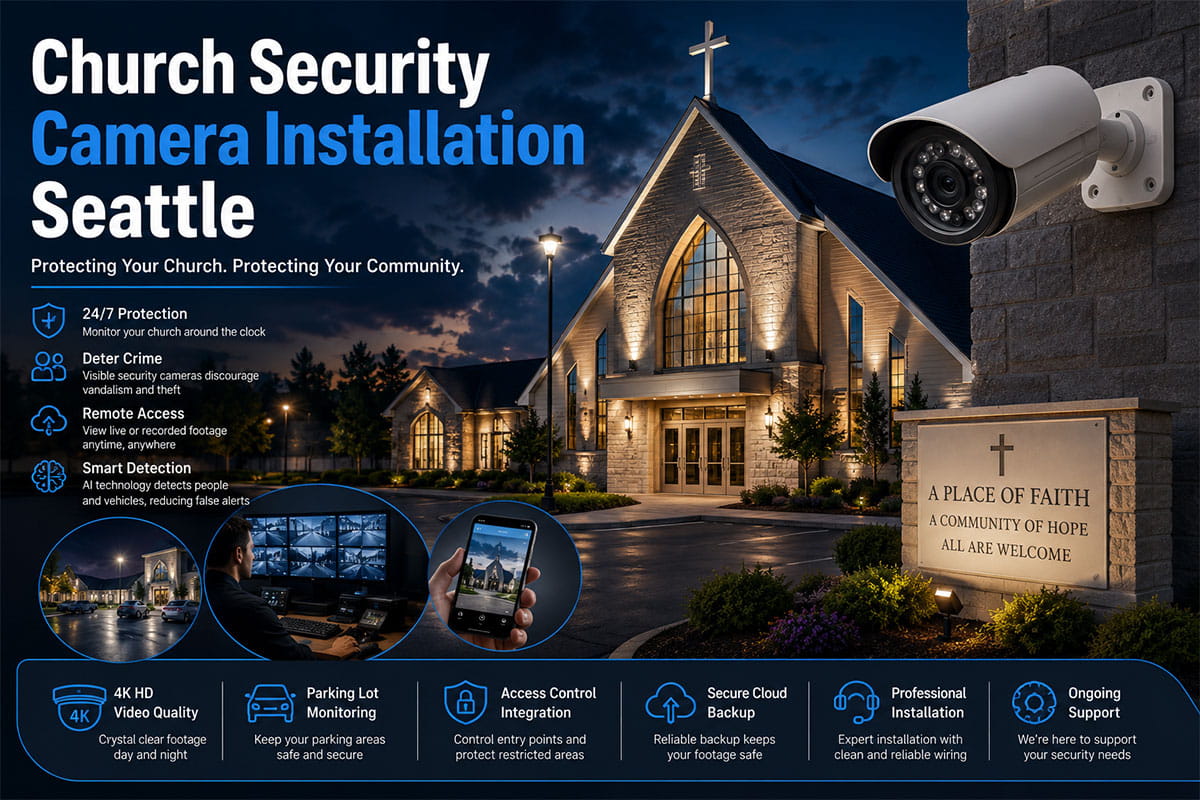
Church Security Camera Installation Seattle helps churches, ministries, synagogues, mosques, temples, community centers, and other places of worship create safer environments for members, visitors, staff, volunteers, and valuable property. Places of worship often have unique security requirements because their buildings may include multiple entrances, large gathering spaces, offices, classrooms, childcare areas, parking lots, and facilities that remain unoccupied during portions of the week.
A professionally designed security camera system provides much more than recorded video. Modern surveillance can combine 4K IP cameras, Artificial Intelligence (AI), secure remote monitoring, Power over Ethernet (PoE), video management, access control integration, and intelligent alerts to create a coordinated security infrastructure.
At CamNetLink, we provide professional Church Security Camera Installation Seattle solutions designed around the actual layout, security concerns, network infrastructure, and operational requirements of each property. Whether the facility is a neighborhood church or a larger multi-building worship campus, the surveillance system should provide useful coverage without unnecessarily monitoring private or sensitive areas.
Why Places of Worship Need Professional Security Cameras
Churches and other religious facilities are designed to be welcoming and accessible, but that openness can also create security challenges. Visitors may enter through different doors, volunteers may access the property outside regular service hours, deliveries may arrive during the week, and large numbers of vehicles and pedestrians may be present during services or community events.
Professional Church Security Cameras Seattle can help provide greater visibility around entrances, parking areas, building exteriors, offices, hallways, gathering spaces, and other appropriate areas of the property.
When an incident occurs, properly positioned cameras can also provide recorded evidence that helps authorized personnel understand what happened and review the event more efficiently.
Common Security Challenges for Seattle Churches
Every place of worship has a different property layout and security profile. A small neighborhood church may need several strategically positioned cameras, while a large campus may require dozens of cameras, multiple network switches, centralized recording, access control, and dedicated surveillance infrastructure.
Common security concerns can include:
- Unauthorized entry into the building.
- After-hours trespassing.
- Vandalism and property damage.
- Theft of equipment or property.
- Parking lot incidents.
- Vehicle-related property damage.
- Unmonitored secondary entrances.
- Activity around offices and restricted areas.
- Large crowds during services and events.
- Security incidents requiring recorded evidence.
Benefits of Church Security Camera Installation Seattle
A professionally engineered surveillance system creates coordinated coverage instead of relying on isolated cameras installed without an overall plan.
Potential benefits include:
- 24/7 monitoring of appropriate areas.
- Greater visibility at entrances and exits.
- Improved exterior and parking lot coverage.
- Recorded evidence for incident investigation.
- Secure remote monitoring for authorized personnel.
- AI-assisted human and vehicle detection.
- Protection of equipment and property.
- Centralized management of multiple cameras.
- Integration with access control systems.
- Scalable infrastructure for future expansion.
Start with a Professional Security Assessment
Effective Church Security Camera Installation Seattle begins before any cameras are mounted. The first step should be evaluating the property to understand how people and vehicles move throughout the facility.
A professional assessment may evaluate:
- Main entrances and exits.
- Secondary and staff entrances.
- Parking lots and vehicle entrances.
- Building perimeter.
- Reception and lobby areas.
- Administrative offices.
- Hallways and common areas.
- Equipment and utility rooms.
- Outdoor gathering spaces.
- Existing network and electrical infrastructure.
The objective is not simply to install as many cameras as possible. Each camera should serve a specific security purpose and provide useful footage for the area it monitors.
Security Cameras for Main Entrances and Exits
Building entrances are among the highest-priority surveillance locations for most places of worship. Members, visitors, volunteers, employees, contractors, and delivery personnel may enter the property at different times throughout the week.
Entrance cameras should be positioned to capture useful identifying detail rather than only providing a wide overhead view. Lighting, mounting height, lens selection, viewing angle, and distance all influence whether recorded footage will actually be useful.
Modern entrance surveillance can also work alongside video intercoms and electronic access control systems to improve visibility and entry management.
Parking Lot Security Cameras for Churches
Parking areas can represent a significant portion of a church property’s security footprint. During services, events, weddings, funerals, meetings, and community programs, dozens or even hundreds of vehicles may enter and leave the property.
Professional parking surveillance can help document:
- Vehicle movement.
- Property damage.
- Suspicious activity.
- After-hours trespassing.
- Pedestrian movement near entrances.
- Incidents involving parked vehicles.
- Activity near isolated sections of the property.
Wide overview cameras can provide general situational awareness, while additional cameras may be positioned at vehicle entrances or other strategic locations where more detailed footage is required.
License Plate Recognition for Vehicle Entrances
Larger worship campuses with defined vehicle entrances may benefit from License Plate Recognition (LPR) technology. Unlike a standard overview camera, an LPR camera is configured specifically to capture readable vehicle plates under expected traffic and lighting conditions.
Successful LPR installation depends on factors such as vehicle speed, camera angle, capture distance, mounting height, lighting, and the expected direction of traffic.
LPR can complement broader parking surveillance by providing searchable vehicle information when appropriate for the facility’s security requirements.
4K IP Security Cameras for Detailed Surveillance
High-resolution IP cameras are commonly used in modern Place of Worship Security Cameras Seattle systems because they can provide detailed recorded footage and integrate with network-based video management platforms.
4K cameras can be useful around entrances, exterior areas, parking facilities, hallways, lobbies, and other locations where image detail is important.
However, resolution alone does not determine surveillance quality. A professionally selected 4K camera with the wrong lens or mounting position can still produce poor evidence. Camera selection should therefore consider the specific objective of each location.
Dome Cameras for Indoor Areas
Dome cameras are commonly used in indoor environments because of their compact appearance and flexible mounting options. They can be suitable for lobbies, hallways, reception areas, administrative spaces, and other appropriate common areas.
Vandal-resistant dome models can provide additional durability in areas with significant public traffic.
Bullet Cameras for Building Exteriors
Bullet cameras are often used for exterior surveillance because they can provide focused coverage over longer distances and are visually recognizable as security equipment.
Potential installation locations include:
- Building perimeter.
- Exterior entrances.
- Parking lots.
- Service entrances.
- Outdoor equipment areas.
- Vehicle access points.
Outdoor security equipment installed in Seattle should be selected for weather resistance and reliable operation in changing environmental conditions.
PTZ Cameras for Large Church Campuses
Pan-Tilt-Zoom (PTZ) cameras can complement fixed surveillance cameras on larger properties. Authorized users can reposition compatible PTZ cameras and zoom into activity occurring across larger outdoor spaces.
PTZ cameras should generally supplement fixed cameras rather than replace them. Fixed cameras provide continuous coverage of important locations, while PTZ equipment can provide additional flexibility for active monitoring.
AI Security Cameras for Smarter Monitoring
Artificial Intelligence can make modern surveillance systems significantly easier to manage. Instead of generating alerts for every movement, properly configured analytics can distinguish between selected types of activity.
Common AI capabilities include:
- Human detection.
- Vehicle detection.
- Line-crossing detection.
- Intrusion-zone detection.
- Loitering detection.
- Object-based video search.
- Scheduled event notifications.
For example, a camera covering a normally empty exterior entrance could be configured to notify authorized personnel when a person enters a defined area during selected hours.
Reduce False Alerts with Proper AI Configuration
AI analytics should be configured around the actual property rather than simply enabling every available detection feature. Trees moving in the wind, vehicle headlights, weather, animals, and normal pedestrian traffic can create unnecessary notifications when detection rules are poorly configured.
A professional installation can define detection zones, schedules, object types, and other parameters to create alerts that are more useful to staff and security personnel.
Protect Administrative and Restricted Areas
Places of worship often contain offices, financial records, computers, audiovisual equipment, network hardware, storage rooms, and other areas that may require additional protection.
Surveillance can provide visual verification around appropriate restricted areas while electronic access control manages who is permitted to enter.
Integrating Security Cameras with Access Control
Video surveillance and electronic access control can work together as part of a more complete physical security system.
Access control technologies may include:
- Electronic door locks.
- Employee or volunteer credentials.
- Key card readers.
- Mobile credentials.
- Video intercom systems.
- Controlled staff entrances.
When properly integrated, access events can be correlated with recorded video, making it easier for authorized administrators to review activity around controlled doors.
Security During Services and Large Events
Churches and worship facilities can experience significantly different traffic levels depending on the day and time. Regular services, weddings, funerals, holiday gatherings, community programs, conferences, and special events may bring large numbers of people onto the property.
A professionally designed system can provide administrators with better situational awareness around entrances, parking areas, common spaces, and other appropriate locations during high-traffic periods.
Surveillance for Buildings Used Throughout the Week
Many churches are not used only for weekly services. Facilities may host meetings, educational programs, community events, rehearsals, volunteer activities, administrative operations, and other programs throughout the week.
Because activity patterns change, surveillance design should consider both high-traffic events and periods when the property is mostly empty.
Privacy Should Be Part of the Surveillance Design
Professional surveillance does not mean installing cameras everywhere. Privacy and the intended use of each area should be considered when planning camera placement.
Areas where individuals reasonably expect privacy should receive particular care. Organizations should also establish appropriate policies regarding who can access recordings, how accounts are managed, why footage may be reviewed, and how long video should be retained.
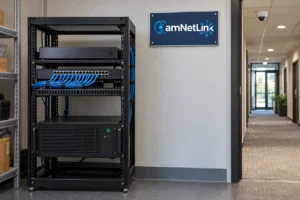
Power over Ethernet for Reliable Camera Infrastructure
Modern IP cameras commonly use Power over Ethernet (PoE), allowing compatible cameras to receive network connectivity and electrical power through Ethernet cabling.
PoE can simplify infrastructure, but larger surveillance systems require careful planning of:
- PoE switch capacity.
- Available power budget.
- Network bandwidth.
- Ethernet cable distances.
- Equipment rack capacity.
- Network segmentation.
- Backup power.
- Future expansion.
Structured Cat6 Cabling for Security Cameras
Reliable structured cabling is an important foundation for network-based surveillance. Professionally installed Cat6 cabling can provide stable connectivity between cameras, PoE switches, recording equipment, and other network infrastructure.
Cable pathways should be planned carefully to create a clean installation, protect network performance, and simplify future troubleshooting or expansion.
Dedicated VLANs for Surveillance Networks
Larger camera systems can generate substantial network traffic. Separating surveillance equipment using properly configured VLANs can improve network organization and provide additional control over how cameras communicate with other devices.
Network design should account for camera count, resolution, frame rate, compression, simultaneous viewing, recording architecture, and other systems sharing the network.
Secure Remote Monitoring
Authorized church administrators or security personnel may need to view live cameras or recorded footage while away from the property.
Remote access should be configured securely rather than exposing surveillance devices directly to the public internet.
Security practices can include:
- Strong unique passwords.
- Multi-factor authentication where supported.
- Encrypted connections.
- Controlled user permissions.
- Secure remote-access configuration.
- Routine firmware updates.
- Removal of unnecessary user accounts.
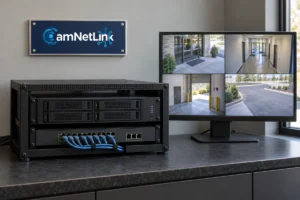
Video Recording and Storage Planning
A surveillance system is only useful if the required footage is available when an incident needs to be reviewed. Storage capacity should therefore be calculated instead of estimated without considering system requirements.
Storage requirements depend on:
- Number of cameras.
- Camera resolution.
- Frame rate.
- Video compression.
- Continuous or event-based recording.
- Activity levels.
- Desired retention period.
A small church and a large multi-building campus can have dramatically different recording requirements.
Backup Power for Critical Surveillance Equipment
Uninterruptible Power Supply (UPS) equipment can help critical network and surveillance components continue operating during short power interruptions and provide additional protection for recording infrastructure.
Backup power planning may include:
- PoE switches.
- Network Video Recorders.
- Core networking equipment.
- Access control components.
- Remote-access infrastructure where appropriate.
Common Church Security Camera Installation Mistakes
Installing more cameras does not automatically create a more effective surveillance system. Poor system design can create blind spots, unusable footage, network problems, excessive alerts, and unnecessary expenses.
Common mistakes include:
- Mounting cameras too high for useful identification.
- Using the same lens for every location.
- Ignoring difficult lighting conditions.
- Failing to cover secondary entrances.
- Insufficient parking lot surveillance.
- Incorrect LPR camera positioning.
- Underestimating storage requirements.
- Exceeding PoE switch power capacity.
- Using weak remote-access security.
- Failing to plan for future expansion.
Security Camera Maintenance for Places of Worship
Surveillance systems should be inspected periodically rather than waiting until footage is needed to discover that a camera or recording device has stopped working correctly.
Preventive maintenance can include:
- Cleaning camera lenses.
- Checking camera alignment.
- Testing recording and playback.
- Reviewing storage health.
- Testing AI detection rules.
- Inspecting network equipment.
- Checking PoE switches.
- Reviewing user permissions.
- Testing remote access.
- Verifying backup power.
Designing a Surveillance System for Future Expansion
Church facilities can change over time. New buildings may be added, parking lots expanded, entrances relocated, additional programs introduced, or existing spaces renovated.
Planning spare network capacity, PoE ports, recording storage, rack space, and cabling pathways can make future surveillance expansion easier and more cost-effective.
Church Security Cameras for Seattle’s Climate
Exterior cameras in the Seattle area may be exposed to rain, moisture, changing temperatures, and challenging lighting throughout the year. Outdoor surveillance equipment should therefore be selected for its installation environment rather than using indoor equipment in exposed locations.
Camera housing, mounting hardware, cable protection, weather sealing, and installation technique all contribute to long-term reliability.
Why Professional Installation Provides Better Results
A professional Church Security Camera Installation Seattle project combines camera placement, structured cabling, PoE networking, recording, cybersecurity, remote access, and future scalability into one coordinated system.
Instead of treating each camera as an isolated device, professional system design considers how the entire security infrastructure works together.
CamNetLink can also integrate surveillance with structured Cat6 cabling, access control, parking lot monitoring, AI video analytics, License Plate Recognition, and network infrastructure for organizations that require a broader security solution.
Church Security Camera Installation Throughout the Seattle Area
CamNetLink provides security camera and network infrastructure services throughout Seattle and surrounding communities, including Bellevue, Redmond, Kirkland, Renton, Issaquah, Mercer Island, Shoreline, Bothell, Lynnwood, Everett, Edmonds, Kent, and nearby areas.
For organizations evaluating broader Security Camera Installation Seattle solutions, our team can design scalable surveillance infrastructure for commercial properties, offices, parking facilities, campuses, community organizations, and other facilities throughout the region.
Frequently Asked Questions About Church Security Camera Installation Seattle
Do churches need professional security cameras?
Security requirements vary by property, but professional surveillance can provide churches and places of worship with greater visibility around entrances, parking areas, building exteriors, common spaces, and other appropriate locations. The system should be designed around the facility’s actual risks and operations.
Where should security cameras be installed in a church?
Common locations include main entrances, secondary entrances, parking areas, building exteriors, lobbies, hallways, administrative areas, and other appropriate common or restricted-access locations. Camera placement should also account for privacy expectations.
Can church security cameras be viewed remotely?
Yes. Compatible modern IP surveillance systems can provide authorized users with secure access to live and recorded video from supported computers and mobile devices. Remote access should be protected using appropriate authentication and cybersecurity practices.
Can AI security cameras detect people and vehicles?
Yes. Compatible AI-enabled surveillance systems can distinguish between selected object types such as people and vehicles and can generate alerts based on configured zones, schedules, and detection rules.
Can cameras monitor church parking lots at night?
Yes, but nighttime performance depends on camera selection, available lighting, installation position, viewing distance, and the surveillance objective. Professional planning helps determine whether infrared, low-light, supplemental lighting, or other technologies are appropriate.
Can License Plate Recognition be installed at a church?
LPR may be appropriate for properties with defined vehicle entrances where searchable plate capture supports the organization’s security objectives. Successful installation requires specialized camera positioning and configuration.
Can church cameras integrate with electronic door access?
Yes. Compatible surveillance and access control systems can work together so authorized administrators can correlate access events with video recorded around controlled doors.
How much video storage does a church need?
Storage requirements depend on camera count, resolution, frame rate, compression, recording schedule, activity levels, and desired retention time. Storage should be calculated for the actual surveillance design.
Can an existing church security system be upgraded?
Often, yes. Existing cabling, cameras, network switches, recording equipment, and other infrastructure can be evaluated to determine what can remain and what should be upgraded or replaced.
How often should church security cameras be maintained?
Systems should be checked periodically. Cameras, recording, storage, remote access, AI rules, networking equipment, and backup power should be tested so problems can be identified before critical footage is needed.
Why Choose CamNetLink for Church Security Camera Installation?
CamNetLink provides professional Church Security Camera Installation Seattle services with surveillance designs tailored to the property rather than relying on a one-size-fits-all camera package.
Our approach can include:
- On-site security assessment.
- Custom surveillance system design.
- 4K IP security cameras.
- AI video analytics.
- Parking lot surveillance.
- License Plate Recognition.
- Access control integration.
- PoE network infrastructure.
- Structured Cat6 cabling.
- Secure remote monitoring.
- Video storage planning.
- Scalable infrastructure design.
- Professional technical support.
Build a Complete Security Infrastructure for Your Place of Worship
A reliable security system should be designed as more than a collection of individual cameras. Surveillance, recording, network switches, structured cabling, access control, remote monitoring, cybersecurity, and backup power should work together as part of a coordinated infrastructure.
Proper planning also makes future upgrades easier. If another entrance, parking area, building, or section of the property requires surveillance later, scalable infrastructure can reduce the complexity and cost of expansion.
Request a Church Security Camera Consultation in Seattle
If your church or place of worship is planning a Church Security Camera Installation Seattle project, CamNetLink can evaluate the property and develop a professional surveillance solution based on its actual layout, security requirements, network infrastructure, and future plans.
Our team can assess entrances, parking areas, building exteriors, existing cabling, network equipment, recording requirements, remote monitoring, AI analytics, access control integration, and other important elements of the project.
Organizations searching for professional Security Camera Installation Seattle services can also work with CamNetLink to create a broader security and network infrastructure strategy designed for long-term reliability and expansion.
Contact CamNetLink today to request a Free Estimate and discuss a professional security camera solution for your church, ministry, place of worship, or community facility in the Seattle area.